Loading blog post...
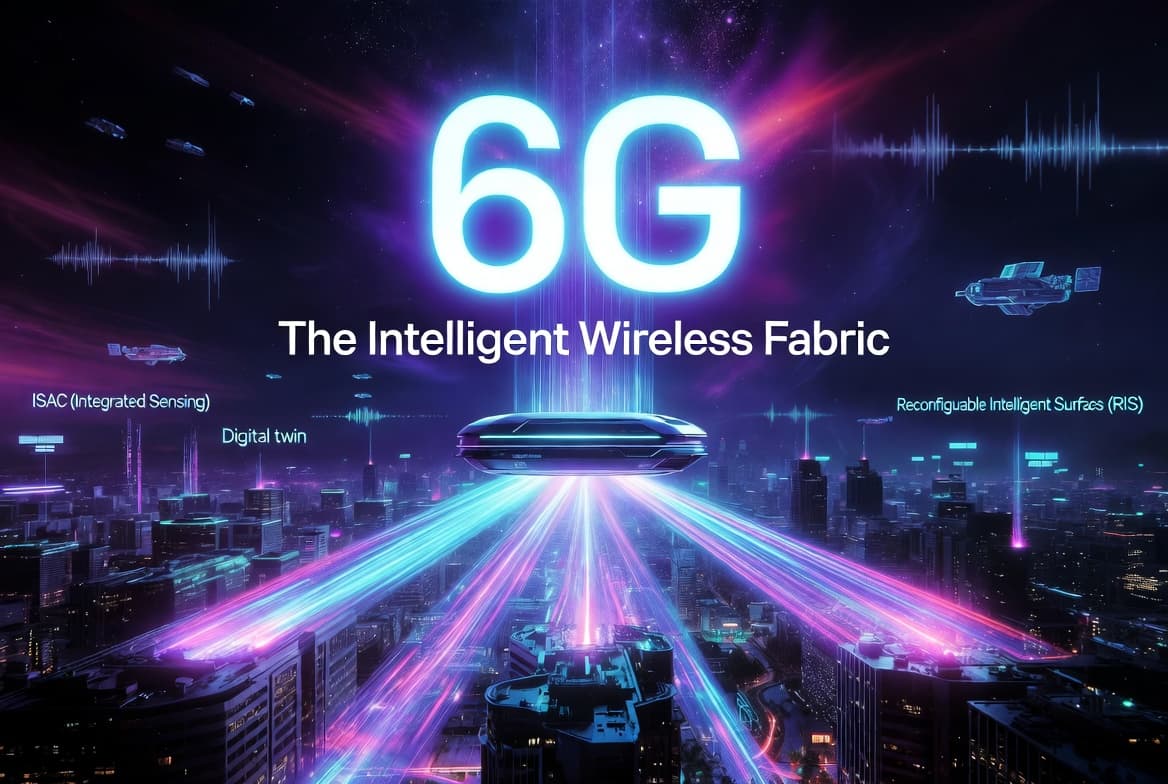
The wireless industry hits a generational reset roughly every ten years. 5G (IMT-2020) delivered on its core promises: sub-millisecond latency, up to 20 Gbps peak rates, and massive device connectivity. It enabled serious industrial IoT, URLLC for automation, and network slicing at scale.
6G (IMT-2030) goes further. It transforms the network from a high-performance data pipe into an AI-native, integrated sensing and communication (ISAC) platform that perceives the physical world, reasons in real time, and adapts autonomously.
This deep technical dive explores 6G's architecture, performance leaps, enabling technologies, real-world benefits, sustainability angle, and the tough engineering challenges ahead.
IMT-2030 Framework and 3GPP Roadmap
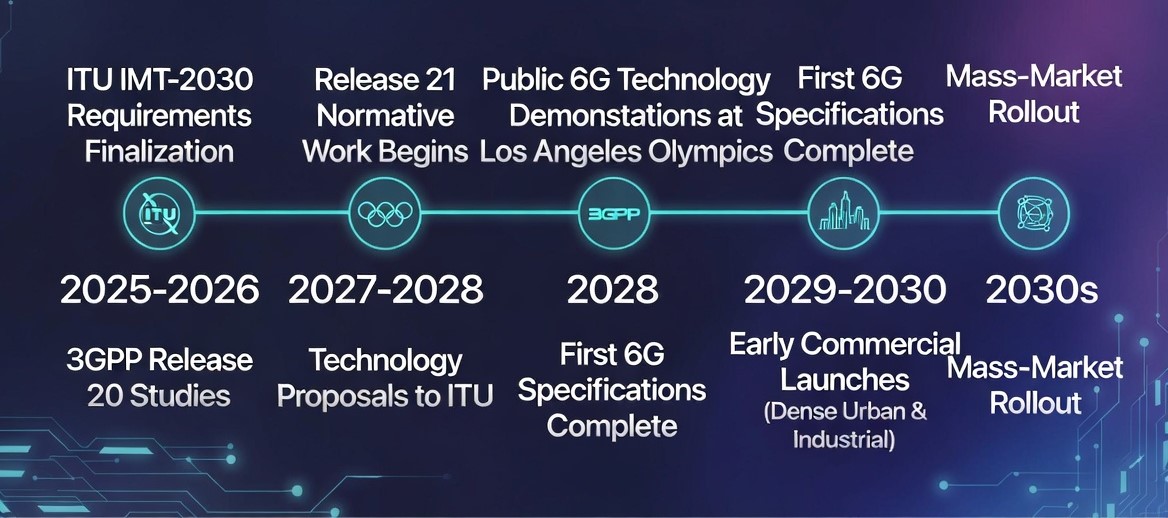
The ITU has finalized draft technical performance requirements for IMT-2030 as of early 2026. Candidate radio interface technologies are expected by 2027–early 2029, with full evaluation leading to official designation around 2030.
3GPP is executing this through two releases:
Release 20 (studies underway since mid-2025): Focuses on foundational 6G work items covering RAN, core network, AI/ML integration, ISAC, and Non-Terrestrial Networks (NTN).
Release 21: Normative specifications for the first 6G features (timeline details expected by June 2026).
Early commercial deployments are targeted for ~2030 in leading markets, with public demos planned for the 2028 Los Angeles Olympics.
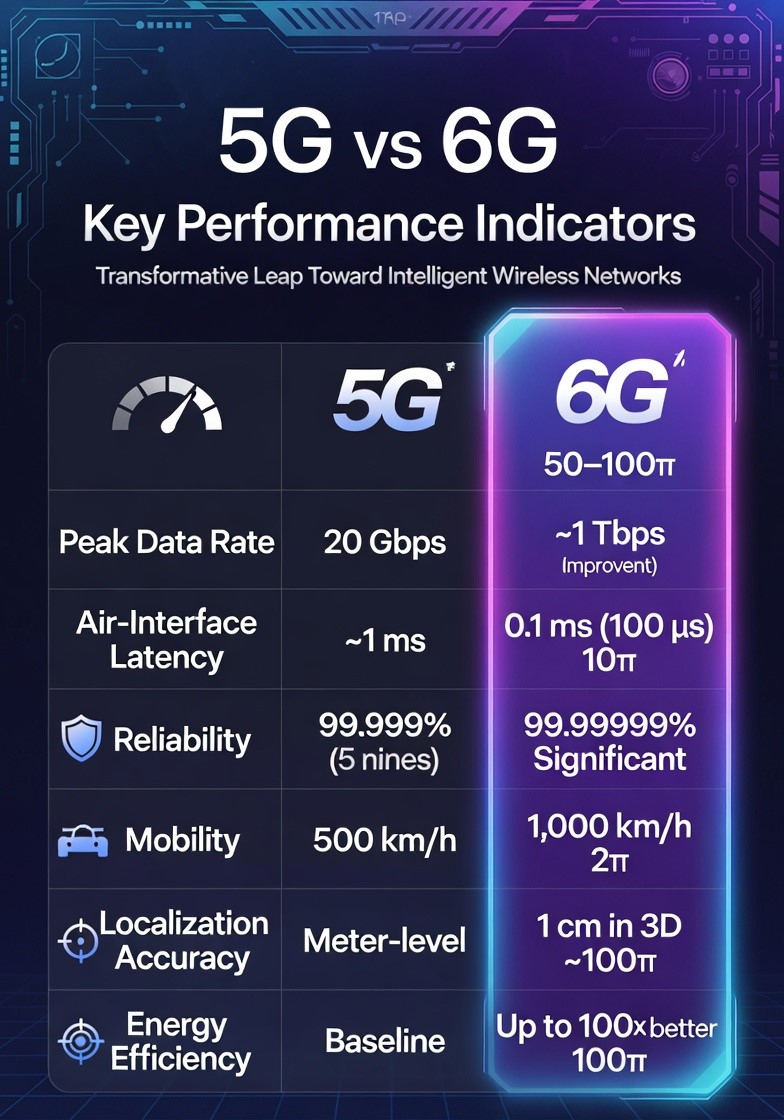
6G targets ambitious gains across key metrics:
Peak data rate: ≥1 Tbps downlink (50–100× over 5G)
Air-interface latency: 0.1 ms (100 µs), with processing delays pushing toward ≤10 ns in aggressive scenarios
Reliability: Seven nines (99.99999%) reducing annual downtime to seconds
Mobility: Up to 1,000 km/h, supporting high-speed rail and seamless LEO satellite handovers
Positioning accuracy: 1 cm in 3D (vs. meter-level in 5G)
Energy efficiency: Up to 100× improvement per bit or per area
These numbers unlock applications impossible or inefficient on 5G: real-time holographic communications, remote robotic surgery with haptic feedback, and high-fidelity digital twins of factories or cities that stay synchronized with sub-millisecond updates.
Spectrum Strategy: Sub-THz for Capacity, Multi-Band for Coverage
To hit terabit rates, 6G heavily leverages the sub-THz band (100–300 GHz initially, extending higher). These frequencies provide hundreds of GHz of contiguous bandwidth, enabling extreme spectral efficiency even with moderate modulation orders.
However, physics bites hard:
Molecular absorption by water vapor and oxygen creates “absorption windows” where propagation works and deep attenuation peaks where signals die quickly.
Free-space path loss scales with the square of frequency → severe attenuation.
Blockage sensitivity: Sub-millimeter wavelengths mean a hand or leaf can break the link.
Hardware limits: Transceivers, power amplifiers, and antenna arrays at these frequencies demand micrometer-level precision and new materials (silicon-photonics, advanced III-V compounds).
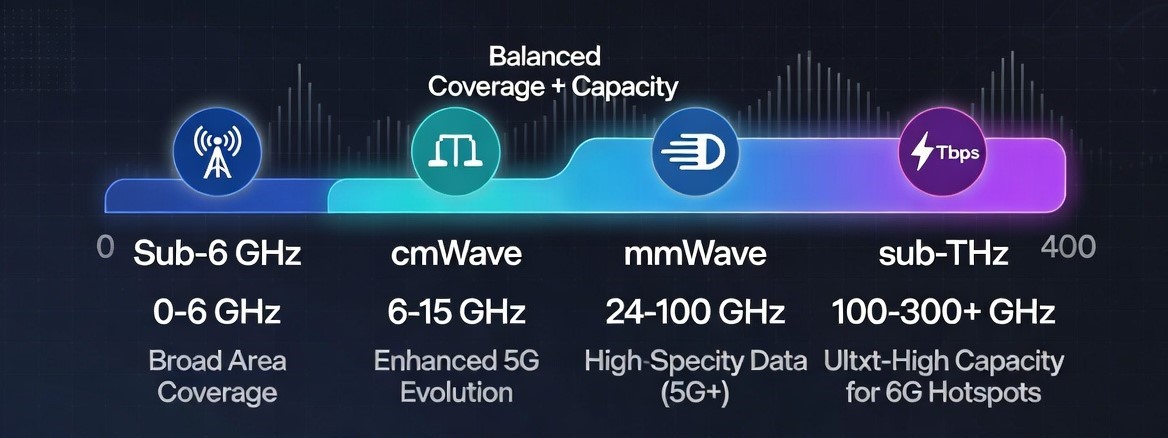
6G will operate as a multi-band system: upper mid-band and cmWave (6–15 GHz) for coverage and mobility, sub-THz for hotspot capacity. This requires intelligent, AI-driven band and beam management across vastly different propagation regimes.
Reconfigurable Intelligent Surfaces (RIS) - essentially programmable metasurfaces will play a major role by dynamically shaping the radio environment, mitigating blockages, and enhancing both communication and sensing.
AI-Native Design: Intelligence Baked into Every Layer
The biggest architectural shift is making AI native rather than an overlay. In 6G, AI/ML models run directly in the RAN, edge nodes, and core for real-time control.
Key integration points include:
Adaptive waveform and receiver design: Deep learning optimizes modulation, coding, and pilot patterns for highly dynamic THz channels where traditional OFDM struggles.
Federated learning: Distributed training across base stations and devices preserves privacy while adapting to local radio conditions.
Graph Neural Networks (GNNs): For resource allocation in heterogeneous networks mixing terrestrial cells, satellites, HAPS, and UAVs.
Deep reinforcement learning: For fast beam tracking and management under mobility and blockage.
Zero-trust security becomes native, with continuous authentication and verification at every layer.
Integrated Sensing and Communication (ISAC)
ISAC is one of 6G’s flagship features. The same waveform, antenna array, and hardware perform both data transmission and radar-like sensing. Base stations become a distributed sensing fabric capable of:
Centimeter-level 3D localization and mapping
Gesture recognition and activity detection
Vital signs monitoring
Environmental awareness for digital twins
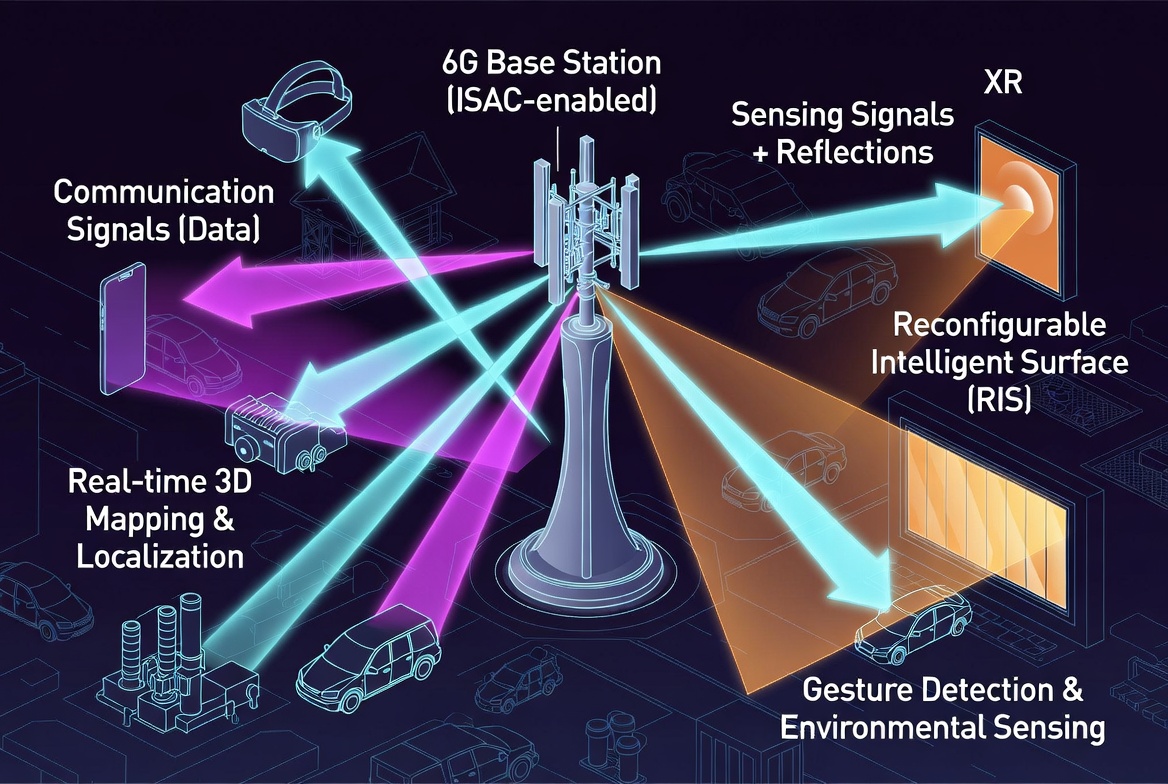
RIS further boosts ISAC by creating virtual line-of-sight paths and improving spatial resolution through coherent reflection combining.
The main technical tension is the sensing-communication tradeoff power, bandwidth, and aperture allocated to one function reduce availability for the other. AI jointly optimizes waveforms and resource allocation to operate efficiently on the Pareto frontier.
Benefits and Use Cases
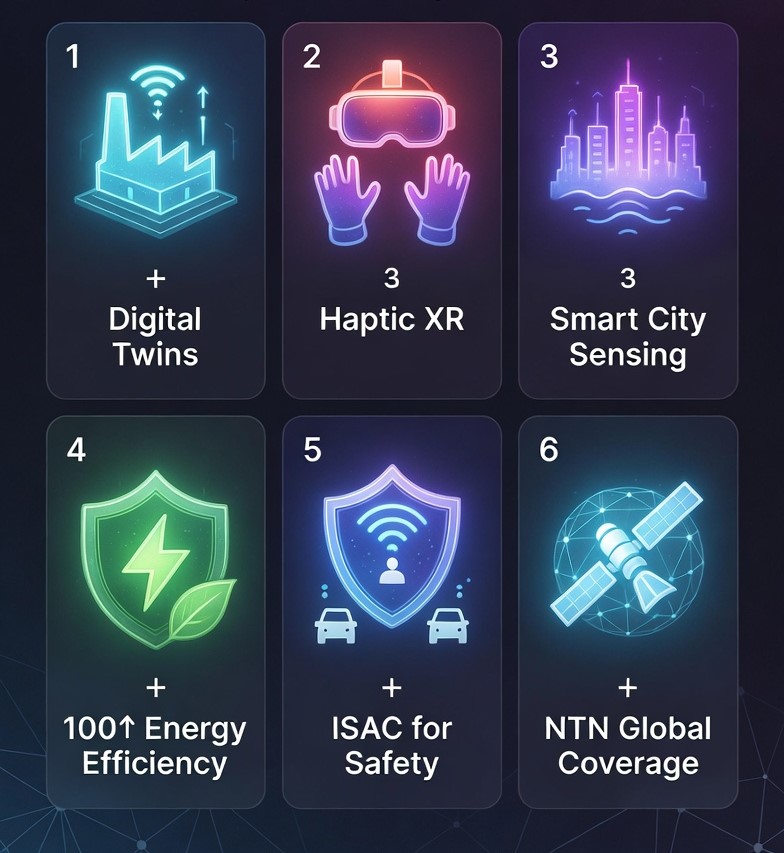
Industrial and enterprise: Real-time digital twins of factories enable predictive maintenance, process optimization, and energy management with minimal downtime. Sub-ms latency + precise sensing supports closed-loop robotic control and autonomous systems.
Immersive experiences: True extended reality (XR) with haptic feedback, high-resolution holographics, and seamless interaction in shared virtual spaces.
Smart cities and public safety: Ambient radio infrastructure monitors traffic, pedestrian flow, air quality, and locates survivors in disasters - all while carrying data traffic.
Connectivity everywhere: Seamless integration of NTN (LEO satellites, HAPS) ensures coverage in remote areas and during high-speed travel.
Overall, 6G shifts value from pure connectivity toward intelligence-as-a-service and perception-as-a-service.
Sustainability Impacts: Greener by Design?
6G faces scrutiny on energy consumption given higher frequencies and denser deployments. Yet the targets include aggressive efficiency goals.
Positive levers:
100× energy efficiency improvements reduce power per bit dramatically.
AI-native optimization enables predictive resource allocation, sleep modes, and dynamic beamforming that concentrate energy only where needed.
Network digital twins simulate and optimize the physical network in advance, cutting operational energy waste and supporting “green” RAN configurations.
RIS provides passive beam steering with near-zero additional power.
Challenges remain: THz components are currently power-hungry, and ultra-dense small-cell + RIS deployments could increase embodied carbon and site energy if not managed carefully. Standards bodies and research projects explicitly address sustainability metrics, including spectrum efficiency and overall environmental footprint.
When successful, 6G networks could support broader sustainability goals from smart grids and precision agriculture to lower-emission industrial processes via digital twins.
Major Engineering and Deployment Challenges
Hardware maturity: Cost-effective, power-efficient THz front-ends and large antenna arrays at scale.
Propagation and coverage: THz links are short-range and blockage-prone; overcoming this requires dense infrastructure and heavy reliance on RIS and relays raising capex questions.
AI reliability and explainability: Mission-critical systems (autonomous vehicles, remote surgery, industrial safety) demand verifiable behavior, fallback mechanisms, and regulatory acceptance.
Spectrum harmonization: Global agreement on sub-THz and mid-band allocations through WRC cycles is essential for roaming and economies of scale.
Security and privacy in ISAC: Continuous sensing raises serious concerns around unauthorized surveillance, data protection, and ethical use.
Geopolitical and supply chain: Leadership in patents, advanced semiconductors, and open standards will determine strategic autonomy.
As of April 2026, 6G is moving from vision to concrete study items in 3GPP Release 20. Normative work in Release 21 will define the first implementable specifications. Early deployments will likely focus on dense urban and industrial campuses around 2030, with broader rollout in the mid-2030s.
6G is not “5G but faster.” It represents a fundamental evolution toward an intelligent wireless fabric that tightly couples communication, sensing, computation, and AI. The combination of sub-THz spectrum, native AI, ISAC, and NTN integration creates a substrate for cyber-physical systems and pervasive digital twins.
Success hinges on solving hard problems in physics, hardware, AI trustworthiness, and sustainable deployment economics. For engineers, researchers, and operators, the next 3–4 years of standards work and early trials will shape the applications and business models that define the 2030s.
The boundary between the digital and physical worlds is about to get a lot thinner.