Loading blog post...

Imagine, you’re on a team that’s just shipped a killer feature in record time. High-fives all around, code’s flying, everyone’s feeling like rockstars. Fast-forward six months. That “small tweak” to add a new payment method? It touches controllers, services, repositories, some config hell, and oh yeah- three different places where business logic leaked into the UI layer. Suddenly your velocity is crawling, bug fixes birth new bugs, and the war room meetings have started. Sound familiar?
That’s the slow-motion car crash most systems don’t survive. Not because the original code was bad, but because every change starts feeling like open-heart surgery with no painkillers. And that’s exactly the decay Uncle Bob goes after in Clean Architecture
The rules of architecture haven’t changed in 50 years.
Different hardware.
Different languages.
Same principles.
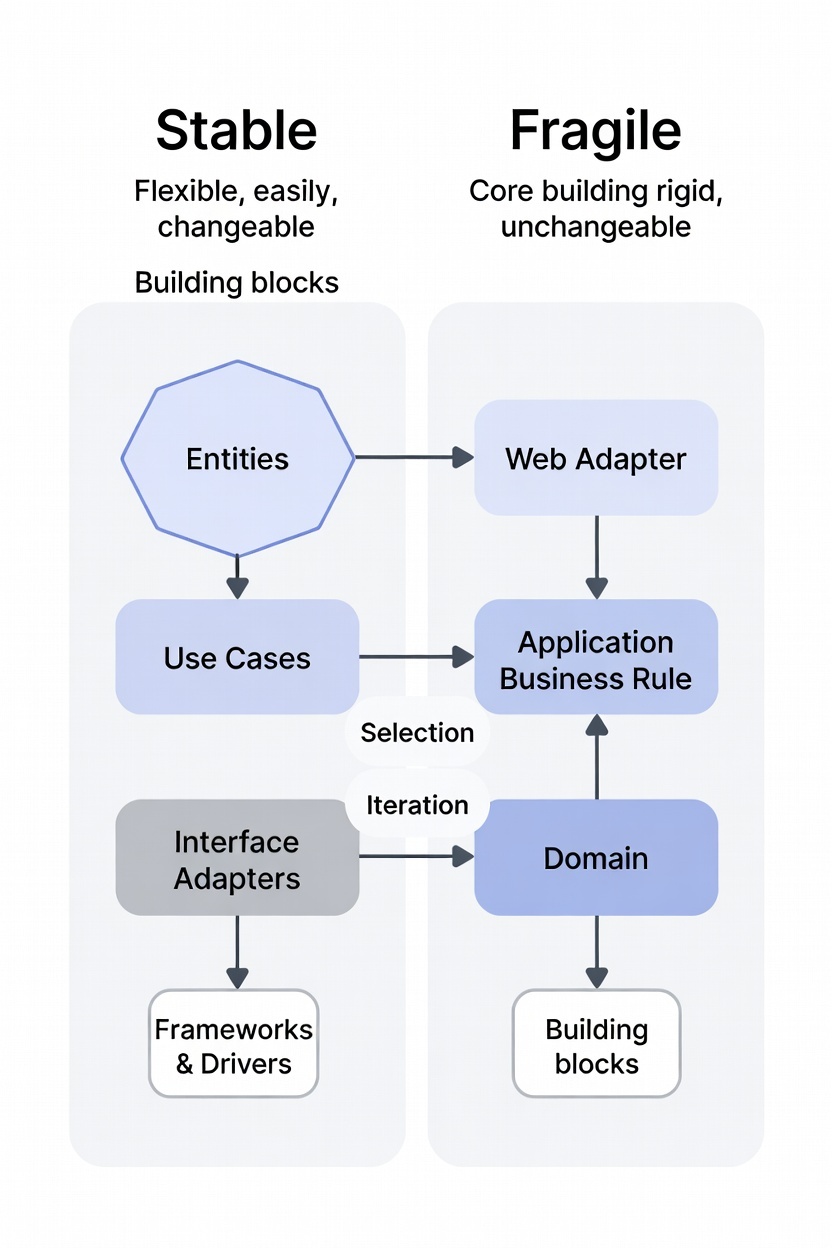
At first, that feels disappointing. We like to believe we’re living in a revolutionary era. But the deeper point is powerful. The core building blocks of software are still sequence, selection, and iteration. The discipline around arranging them is what separates stable systems from fragile ones.
Architecture, he argues, has one job:
Minimize the human effort required to build and maintain a system
The book opens by dismantling a common misunderstanding: architecture and design are not separate layers of importance. They’re part of the same fabric.
But the more interesting idea is this tension:
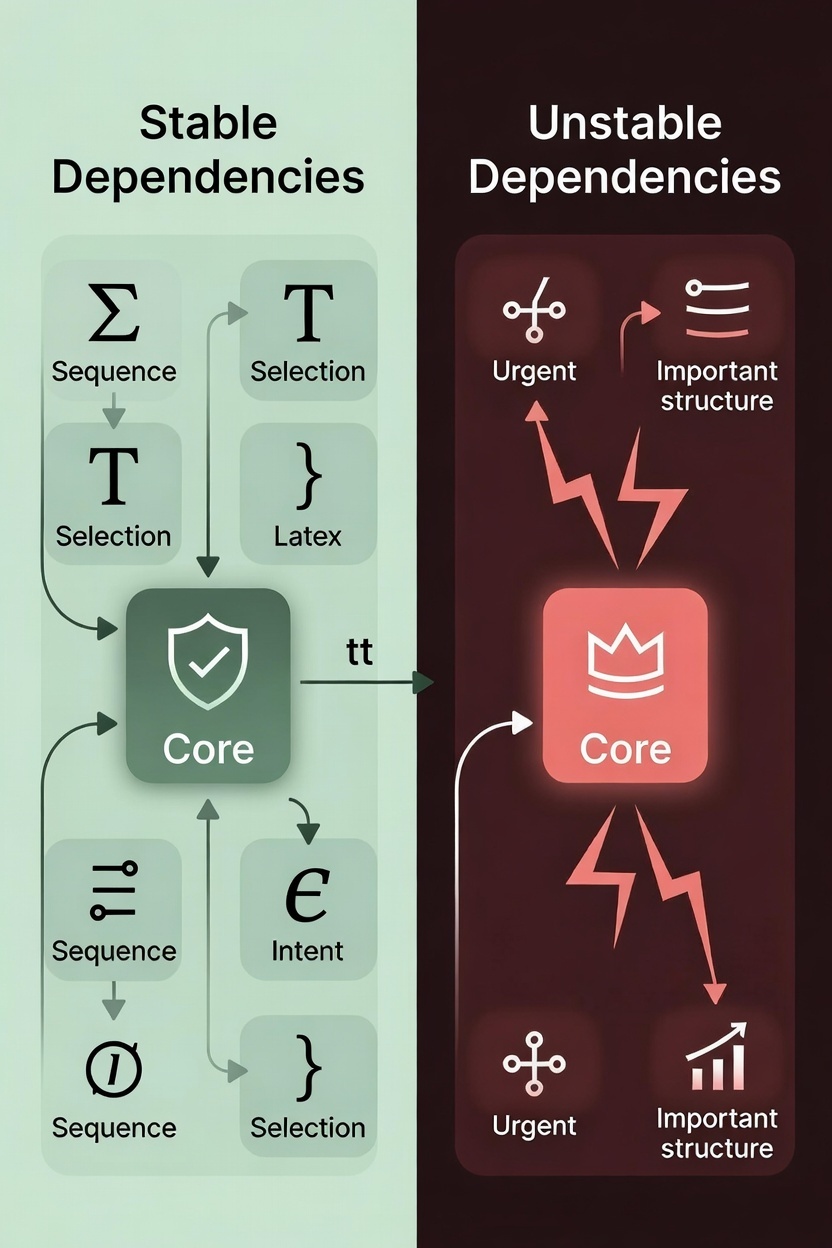
Behavior is urgent
Structure is important
Behavior is urgent, features pay the bills. Structure is important, it’s what lets you keep shipping features next year without wanting to quit. Guess which one wins every sprint? Behavior. Always. Teams chase velocity, pile on patches, and whisper “we’ll refactor later.” Later never shows up. Instead you get the classic hockey-stick curve: costs skyrocket, morale tanks, and suddenly you’re maintaining a system that’s working but impossible to evolve.
Uncle Bob flips the script with a line that still makes me pause, a working but unchangeable system is worse than a broken but easily changeable one. Harsh? Maybe. True? Absolutely. Because software’s only superpower is that it’s soft. If it hardens into concrete, you’ve lost the game.
The Quiet Discipline of Paradigms
Then the book goes backward in time.
Structured programming
Object-oriented programming
Functional programming
Instead of celebrating them as power boosts, Martin frames them as restrictions. Structured programming removes reckless control flow. OOP disciplines indirect control through polymorphism. Functional programming restricts mutation.
Notice the pattern? Each paradigm removes freedom.
That’s a subtle but profound idea: architecture isn’t about gaining more power. It’s about reducing chaos.
Discipline creates clarity. Clarity enables boundaries. Boundaries enable architecture. If you’ve ever wondered why SOLID matters at scale, this can be your groundwork. In this book, SOLID grows up.
SRP becomes about aligning code with reasons to change
OCP becomes about controlling extension direction
LSP becomes about behavioral guarantees across boundaries
ISP reduces unnecessary coupling pressure
DIP becomes the engine of architectural control
The component stuff hits different when you’re a senior. Acyclic Dependencies Principle, kill those cycles before they kill your refactor. Stable Dependencies, don’t let flaky, rapidly-changing stuff drag down your stable core. Stability vs. abstraction trade-off: if something’s rock-solid stable, it better be abstract enough to flex, or it becomes an anchor. I’ve felt that drag in codebases. Now I can name it.
And then - the circles. You know the ones. Entities at the center (pure business rules, no tech). Use cases around them (application-specific orchestration). Interface adapters (controllers, presenters, gateways). Outermost ring: frameworks, drivers, UI, DB etc all details. Dependency rule: nothing points outward. Inward only. Database is a detail. Web is a detail. Spring, Rails, whatever details. If ripping out your ORM bricks the system, your business logic was never independent. That’s not architecture; that’s captivity.
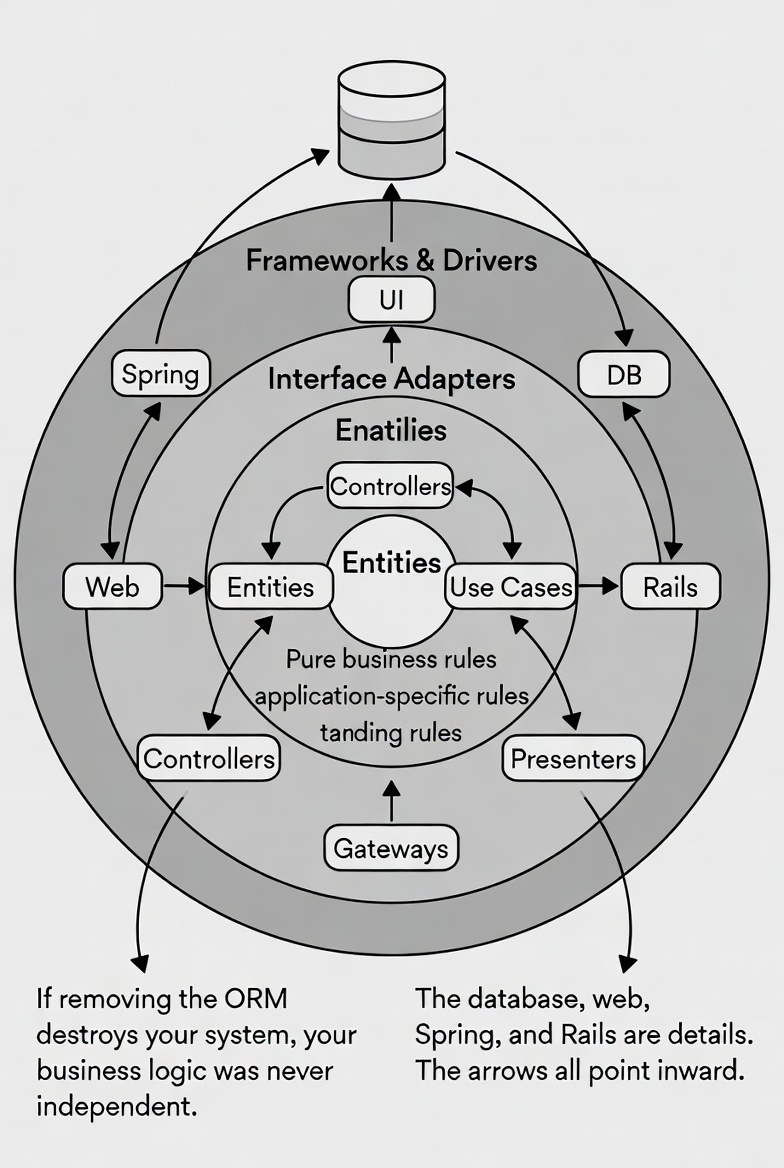
He calls it Screaming Architecture. Your architecture should scream what the system does, not what framework it uses. If someone opens your project and the first thing they see is a SpringBootApp instead of OrderProcessing, something is off.
So, architectures should announce the business domain, not the toolset.
If you’re moving from developer to system thinker, this book sharpens your lens. If you’re leading teams and feeling velocity slowly decline, this book explains why. If you’re building long-lived SaaS products, enterprise systems, or modular platforms, it will change how you think about dependency direction.
It’s framework-agnostic. It doesn’t care about trends.
It focuses on cost curves and human effort.
It challenges the lie that we can clean it later. It connects low-level discipline with high-level structure.
It stays focused on something more fundamental:
Change must remain cheap!