Loading blog post...
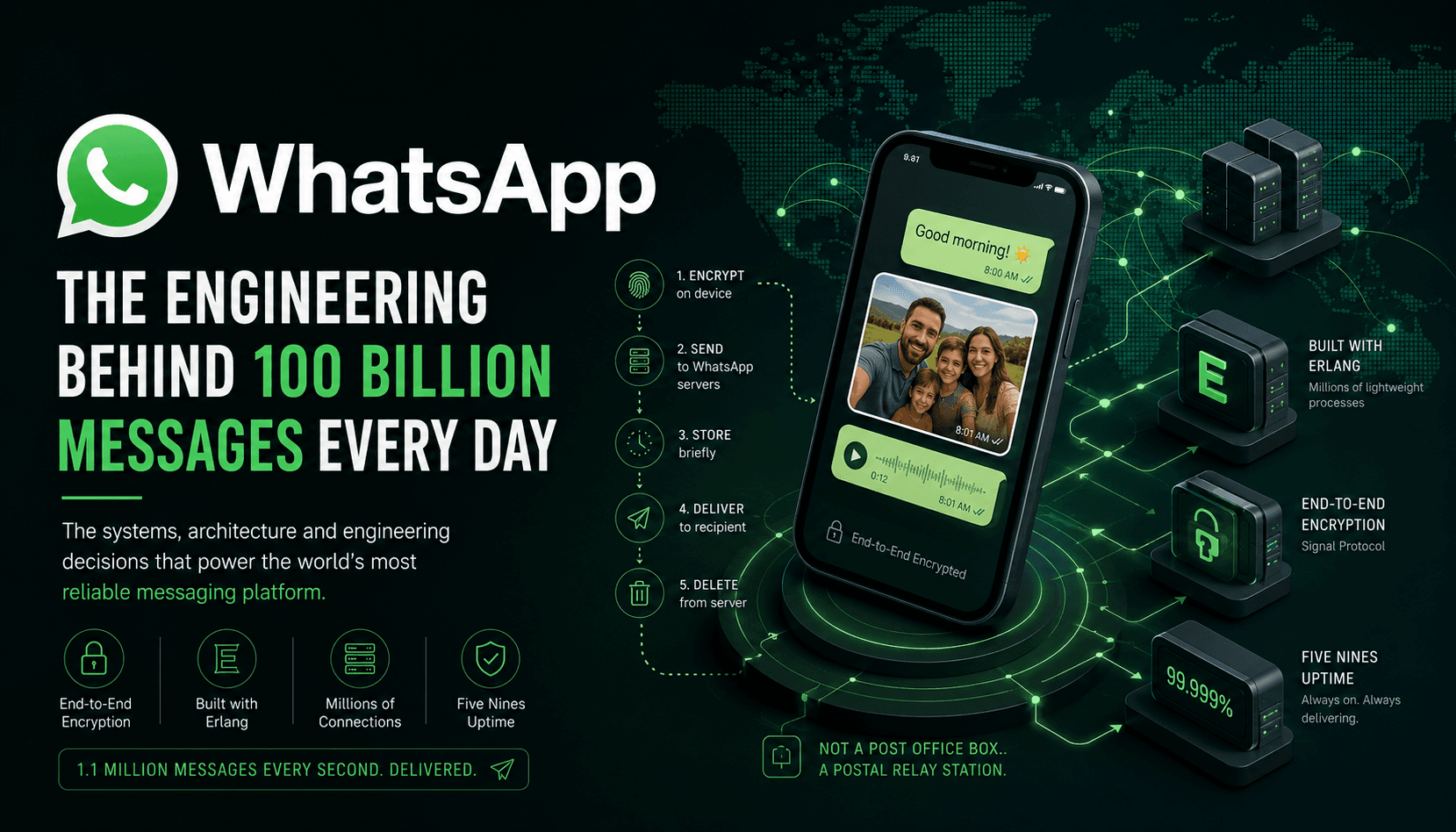
Right now, somewhere in the world, someone just sent a "good morning" text. Then someone replied with a selfie. Or a whole family group chat exploded with memes. All at the exact same time. Multiply that by two billion people, and that's WhatsApp.
One hundred billion messages every single day. That's 1.1 million messages every second. Not just simple texts, voice notes, video calls, images, documents, status updates - all delivered reliably fast, and securely.
When WhatsApp was acquired by Facebook in 2014 for $19 billion, only had 55 engineers were serving hundreds of millions of users. How? Let's break it down.
The Life of a Message: From Your Thumb to Their Screen
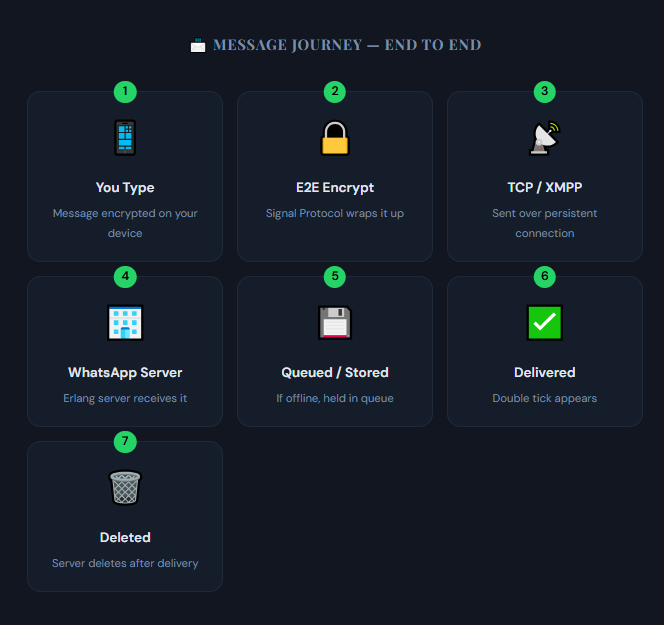
Think of sending a WhatsApp message like mailing a letter but instead of days, it takes milliseconds. Here's what actually happens when you hit send: the message is encrypted on your phone, securely travels through WhatsApp’s servers, waits if needed, gets delivered to the receiver, and is then removed from the server. That last step is critical. Unlike Instagram DMs or emails that live on servers forever, WhatsApp deletes your messages from their servers the moment they're delivered. That's not just a privacy feature, it's also how they keep storage costs manageable at mind-bending scale. WhatsApp's server is like a postal relay station, not a post office box. It holds your letter just long enough to hand it off then immediately clears the shelf for the next million letters.
Why WhatsApp relied on a 30-Year-Old Language
Most tech startups reach for Go, Node.js, or Python. WhatsApp chose Erlang - a language built in the 1980s for telephone networks. Sounds crazy. Turns out, it was genius.
And why does it matter?
Imagine you have a call centre. Each call is handled by a separate person. If one person goes crazy and starts yelling (crashes), you just fire that one person, everyone else keeps working. That's Erlang.
Erlang was designed by Ericsson for telecoms, where crashes are unacceptable and millions of concurrent connections must be managed. Sound familiar? That's exactly what messaging apps need.
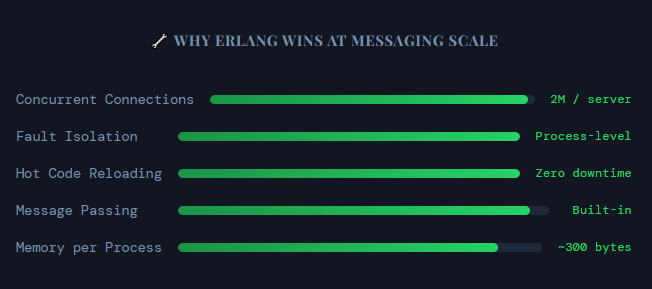
Each WhatsApp server runs millions of lightweight Erlang processes - one per connected user. They're so tiny that a single server can hold 2 million simultaneous connections. When your app is open, you have a dedicated Erlang process waiting just for you. That's not possible with traditional threads, which eat megabytes of RAM each.
One of Erlang's superpowers is that you can update code while the system is running like replacing a car's engine at 100 mph without slowing down. WhatsApp pushes server updates without any downtime whatsoever. Your midnight "goodnight" message never hits a "we're updating, try again later" screen.
The Architecture: What's Actually Running
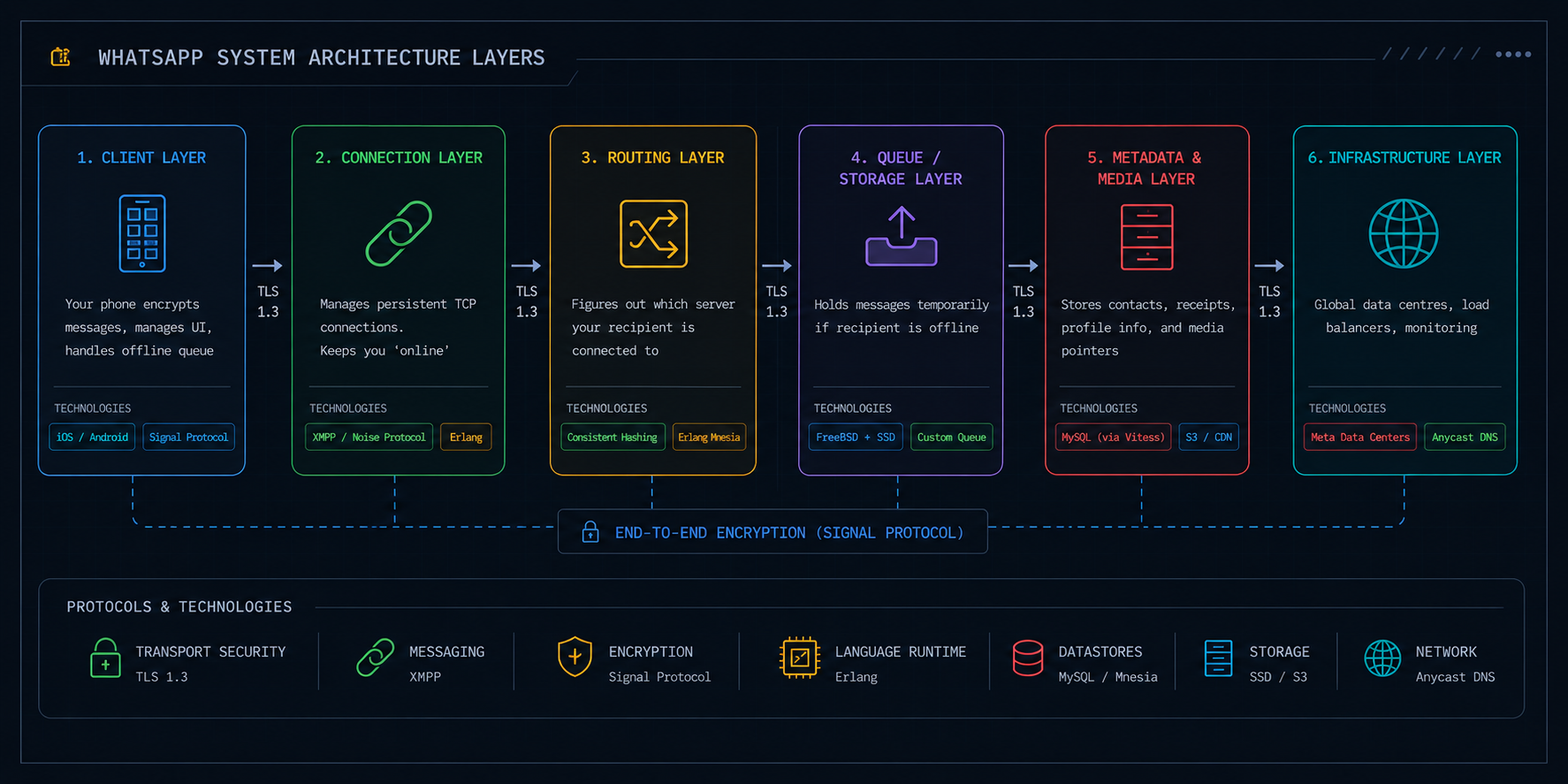
WhatsApp's backend isn't one big server - it's a layered system where each layer has a specific job. Think of it like a well-run restaurant: the host, the waiter, the kitchen, and the supply chain all do different things but work together seamlessly. WhatsApp's messaging protocol is based on XMPP (Extensible Messaging and Presence Protocol) - originally designed for instant messaging in the early 2000s. But WhatsApp heavily modified it. They added binary encoding (instead of verbose XML) which dramatically reduced bandwidth. Your one word message costs you less data than you think.
Later, WhatsApp moved towards a custom protocol called Noise (layered over TLS), making connections even faster and more secure. Every connection is encrypted end-to-end, meaning even WhatsApp's own servers can't read your messages.
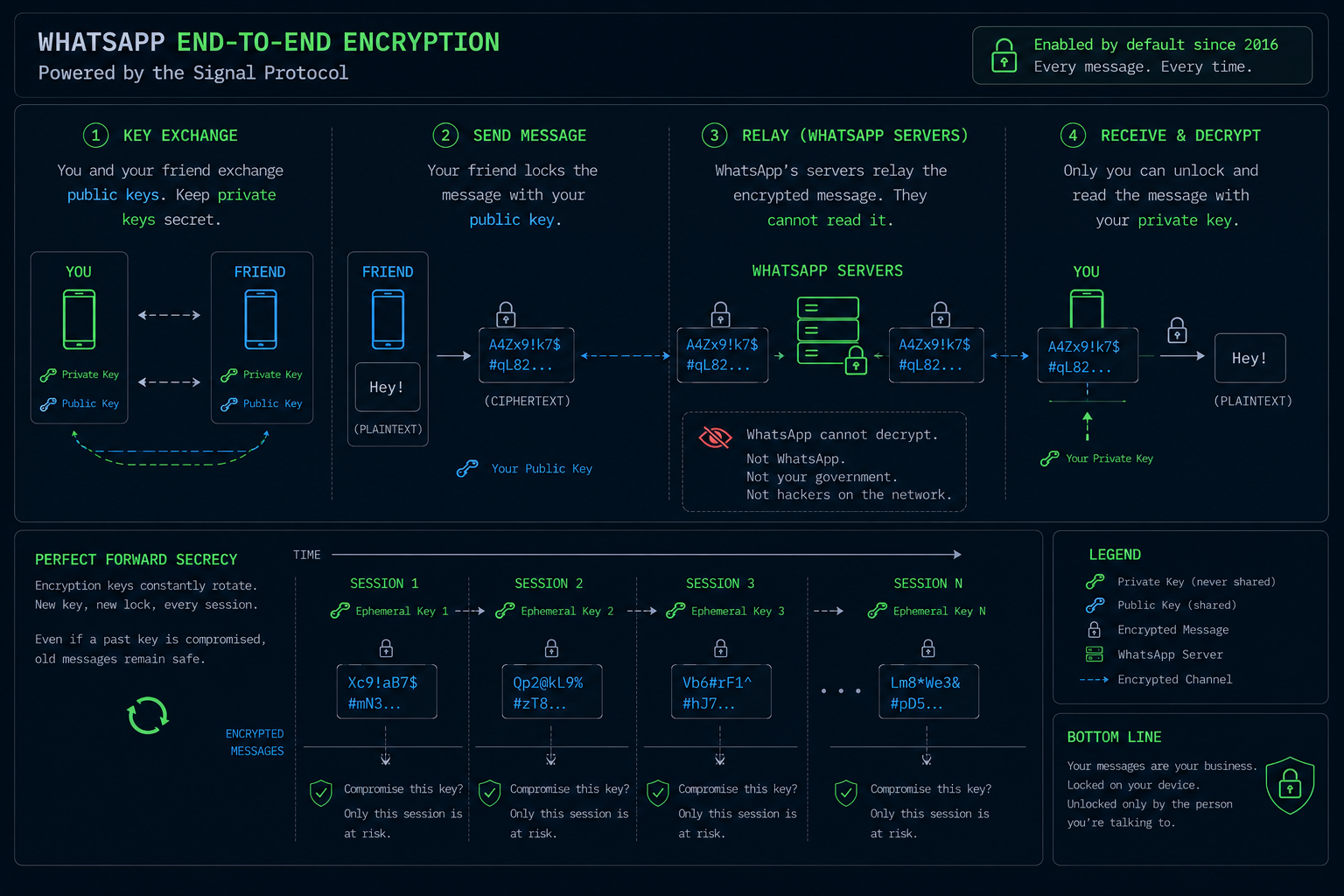
In 2016, WhatsApp made a bold move: they enabled end-to-end encryption for every message by default, using the Signal Protocol. The same protocol used by Signal itself, widely regarded as the gold standard. Imagine you and your friend each have a magic lockbox. You both exchange copies of your padlock (public key) while keeping your unique keys secret (private key). To send you a message, your friend locks it with your padlock. Only you with your secret key can open it. Not WhatsApp. Not your government. Not hackers intercept on the network.
WhatsApp's servers pass along locked boxes they literally cannot open. Even if someone subpoenas WhatsApp, they can only hand over encrypted ciphertext - meaningless without the recipient's private key, which never leaves their device. The Signal Protocol also has a feature called Perfect Forward Secrecy - encryption keys constantly rotate, so even if a past key were somehow compromised, your old messages remain safe. New key, new lock, every session.
Five Nines Uptime: How They Almost Never Go Down
99.999% uptime means only 5 minutes of downtime per year. Achieving that at billion-user scale is an engineering art form.
How they do that? -
Geographic Distribution: Data centres on multiple continents. If one region fails, traffic re-routes automatically within seconds.
No Single Point of Failure: Every critical service runs in triplicate. One goes down, two keep running. Users never notice.
Graceful Degradation: When overloaded, features like read receipts and last seen may delay but messages always get through.
Client-Side Queue: Your app retries sending automatically. You never have to hit "resend" because the app handles it silently.
Chaos Engineering: They intentionally break systems in testing to discover weaknesses before real users ever feel them.
Hot Code Reloads: Erlang lets them deploy updates while the system runs. Zero restart, zero downtime, magic.
What Every Developer Can Learn from WhatsApp
WhatsApp's architecture is a masterclass in engineering philosophy. I got some core lessons:
Choose boring technology wisely. Erlang was "old" but perfectly suited for the problem. The best tool is the one that fits.
Design for failure, not success. Every component assumes it will fail eventually. Redundancy, graceful degradation, and retries are baked in from day one.
Delete data aggressively. Not storing messages long-term wasn't just a privacy win, it dramatically simplified their data management at scale.
Separation of concerns saves lives. Media goes on CDN, messages go through Erlang, metadata in MySQL. Each layer is optimized for its specific job.
So next time you send a "seen this?" meme at 2am, remember: somewhere, a cluster of Erlang processes is awake for you. A CDN is caching your blurry video. An encryption key is doing math and it all happens in about 300 milliseconds.
"The most scalable system is often the simplest one. Ruthlessly stripped of everything that isn't essential." - Jan Koum, WhatsApp Co-founder