Loading blog post...
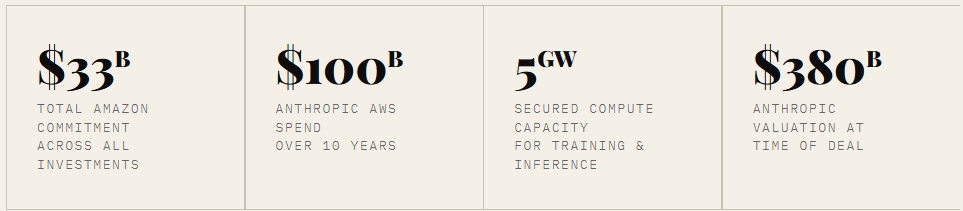
Anthropic said Amazon will invest another $5 billion immediately and could add up to $20 billion more over time, while Anthropic commits to spending more than $100 billion on Amazon Web Services over the next decade. The arrangement also includes up to 5 gigawatts of AI capacity and deep use of Amazon’s Trainium2 and Trainium3 chips, making the partnership one of the largest AI infrastructure agreements disclosed so far.
Anthropic was founded in 2021 by Dario Amodei, Daniela Amodei, and a cohort of researchers who walked out of OpenAI over strategic and safety disagreements. From day one, the company carried a different ideology - one where safety research and frontier capability aren't opposing forces but the same project. That founding DNA matters for understanding why the Amazon deal looks the way it does. Annualized revenue at Anthropic has now surpassed $30 billion - up from roughly $9 billion at the end of 2025. That kind of growth puts immense pressure on infrastructure, and Dario Amodei said it plainly in the announcement: peak usage hours were already hitting reliability. This deal was partly triage, partly long-horizon strategy.
Amazon made its first major bet on Anthropic back in 2023, designating AWS as the primary cloud provider. Then again in 2024 as the primary training partner. By the time this new agreement dropped in April 2026, the two companies had already built something together that nobody talks about enough: Project Rainier, one of the largest AI compute clusters ever assembled - nearly half a million Trainium2 chips spread across US data centers, with the Indiana campus alone spanning 1,200 acres.
Why Each Party Signed
For Amazon, the core issue is chip credibility. Nvidia has had a stranglehold on AI workloads that AWS has been quietly desperate to break. Trainium2 was the answer on paper, but you don't prove custom silicon in a press release, you prove it by running the world's most demanding model on it at scale for years. Locking Anthropic into a decade of Trainium workloads is Amazon's proof of concept, signed in $100 billion. Beyond silicon, there's the market narrative: AWS needed to show the world it's not just a commodity cloud for AI - it's the platform where frontier labs actually operate. Having Anthropic as both a customer and a resident is that story made real.
For Anthropic, the problem was simpler and more immediate: it was running out of headroom. You can't train frontier models on vibes and goodwill - you need compute that scales predictably, globally, and ahead of demand. The five gigawatts of secured capacity, with a roadmap from Trainium2 through Trainium4 and future silicon generations, is essentially Anthropic buying certainty in a market where compute has become the scarcest strategic resource. It also isn't exclusive - Anthropic continues to run workloads on Google Cloud and Azure but AWS is now clearly the primary venue for the heaviest training runs.
There's a deeper dynamic here that I think gets under-discussed: the deal inverts the usual investor-startup relationship. Typically, you take money and spend it however you want. Here, Anthropic takes money and commits to spending $100 billion back to the investor's infrastructure. Amazon is simultaneously a financial backer, a customer, a chip vendor, and a data center landlord. That's a level of structural entanglement that has no real precedent in tech at this scale.
What's Actually in the Agreement
Most coverage stops at the headline numbers, but the architecture of this deal is where the interesting engineering and business logic lives. Let me break it down the way I'd think about it as a developer evaluating a system design.
Equity Structure: $5B deployed immediately at Anthropic's latest valuation, with up to $20B more tied to "commercial milestones." This is milestone-gated capital - Amazon doesn't just write a blank check. If Anthropic grows at pace, Amazon deepens exposure. This aligns incentives rather than just throwing money at the problem.
The $100B AWS Commitment: Anthropic pledges to spend over $100 billion on AWS technologies across the decade. This covers Trainium2, Trainium3, Trainium4, Graviton CPUs, and future custom silicon generations. It's structured as a runway - not a single lump-sum purchase but a rolling commitment that keeps Anthropic on AWS as its infrastructure of record.
5 Gigawatts of Capacity: This is the most technically significant clause. Anthropic has secured up to 5GW of compute capacity for Claude training and inference, spanning data centers across the US, Asia, and Europe through 2036. Nearly 1GW of Trainium2 + Trainium3 capacity is expected online by end of 2026, with significant Trainium2 already coming online in Q2.
Project Rainier Expansion: The existing cluster, currently half a million Trainium2 chips will be scaled to over one million. The Indiana campus alone is targeting 2.2GW at full build-out. This is the physical backbone of Anthropic's training operations for years to come.
Claude Platform on AWS: AWS customers can now access the full Anthropic-native Claude console from within their existing AWS account. No separate contracts, credentials, or billing. This is a distribution play: it makes Claude the path of least resistance for the 100,000+ organizations already running models on Bedrock.
Co-designed Silicon: Anthropic engineers work with Amazon's Annapurna Labs on a near-daily basis, feeding Claude training workload data directly into the design of next-generation Trainium chips. This is a chip R&D co-venture baked into a cloud contract, an unusual and strategically powerful arrangement.
What's notably absent from most reporting is the international expansion angle. The agreement specifically includes inference capacity in Asia and Europe, a direct acknowledgment that Claude's user growth is no longer US-centric and that latency-sensitive enterprise workloads require regional infrastructure.
What This Means for People Who Use Claude
Let's be direct: if you've been on Claude.ai recently, especially on free or Pro tiers - you've likely noticed degradation. Slower responses, occasional timeouts during peak hours, the quiet frustration of a product outgrowing its own infrastructure. Dario Amodei acknowledged this explicitly in the announcement, which is unusual candor for a CEO and tells you just how acute the problem has become.
The immediate relief from this deal is capacity. Significant Trainium2 compute is already coming online in Q2 2026, with nearly a full gigawatt of combined capacity expected before year end. For everyday users, that means the degradation during peak hours should start to ease materially within months, not years.
For enterprise users and developers, the integration of Claude Platform into the AWS console is the bigger change. If your team already lives in AWS, IAM roles, CloudWatch, billing dashboards - Claude is now a first-class citizen in that environment. No new vendor contract, no separate API key management, no separate billing relationship. It collapses what used to be an integration task into a toggle. That's genuinely useful friction removal.
The longer-term user impact is harder to see but arguably more important: with secured compute through 2036, Anthropic can actually plan model development on multi-year horizons. Training frontier models requires knowing you'll have the chips when you need them. That certainty should, in theory, translate to more ambitious model releases on more predictable timelines. Whether that plays out in practice is another question - but the structural conditions for it are now in place.
What This Does to the Rest of the Field
This deal didn't happen in isolation. OpenAI has its own titanic infrastructure arrangement with Microsoft. A relationship that's been the template for everyone else. Google has held a multi-billion dollar stake in Anthropic since early on and recently expanded that arrangement. Anthropic also has a $5B investment from Microsoft with a $30B Azure compute commitment attached. The result is a paradox worth sitting with: Anthropic is simultaneously the preferred AI partner of all three major cloud providers.
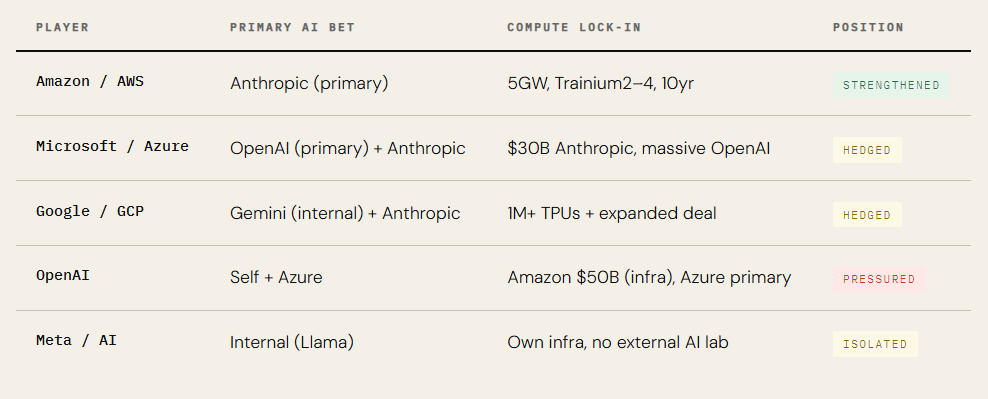
OpenAI is the most directly pressured by this. Its executives have been publicly criticizing Anthropic for not acquiring enough compute which reads less like competitive analysis and more like anxiety about what just happened. Anthropic going from infrastructure-constrained to infrastructure-secured in one announcement is exactly the kind of strategic shift that changes the narrative arc of a company.
For Google, there's a fascinating duality: it competes with Anthropic on Claude vs. Gemini in the enterprise market while simultaneously being one of Anthropic's biggest infrastructure backers. This isn't unique to AI venture-era tech has always involved strange bedfellows - but the scale here is unprecedented. Google has a financial incentive for Anthropic to succeed at the same time it has a competitive incentive for Gemini to win.
The broader market implication is that infrastructure has become the moat. Not model architecture. Not research talent. Not even safety philosophy. The companies that locked in compute pipelines early and did so across multiple silicon generations are the ones with defensible positions through the rest of this decade. Everyone else is renting on month-to-month terms in a seller's market.
There's also a chip dimension that deserves its own paragraph. Amazon betting $100B+ of Anthropic's future on Trainium is an existential endorsement of non-Nvidia silicon in production frontier AI. If Trainium performs and the early workload data from Project Rainier suggests it's credible. It weakens Nvidia's grip on the AI training market at exactly the moment when everyone is looking for an alternative. Intel, AMD, Google TPUs, and custom silicon teams everywhere are watching this closely.
My Thoughts
The way I think about this deal is as a crystallization of a shift that's been building for three years: AI labs are no longer software companies that rent compute. They are infrastructure tenants with decade-long leases, co-designing the building with the landlord. The line between the model and the machine it trains on is blurring in ways that are structurally profound.
What Anthropic has done somewhat quietly, across simultaneous deals with Amazon, Microsoft, and Google is ensure that no single cloud failure takes them down, while still giving Amazon the primary relationship that makes AWS look essential. That's sophisticated positioning. You can't build Claude 5 or 6 worrying whether the GPUs will be there when you need them.
As someone who builds with Claude daily, the near-term relief on reliability matters more to me than the trillion-dollar board game being played above. But understanding the board game is how you understand why your API calls might actually get faster this summer. Infrastructure isn't abstract. It lands in response times, in uptime percentages, in whether the thing you're building works at 2am when you're trying to ship.
The AI race has always been about talent, data, and compute. Two of those three are hard to see from the outside. Compute just got a very visible, very expensive scoreboard.
"The AI race is no longer about who has the best model. It's about who controls the ground the models run on"