Loading blog post...

A couple of years ago the question was simple: What can we even do with AI?
Today it sounds urgent: How do we convert this AI capability into business impact fast?
That objective shift is seismic. We’re no longer in the era of endless experimentation, flashy demos, or AI for the sake of sounding innovative. We’re entering the era where speed, execution, and redesign decide...who leads and who becomes irrelevant.
The Unprecedented Speed of Adoption
Consider the raw velocity.
The telephone took roughly 50 years from Alexander Graham Bells 1876 patent to widespread household penetration in the United States reaching millions of lines only by the 1920s to 1930s.
The Internet from early commercialization in the early 1990s required 7 to 10 years to achieve broad consumer and business adoption.
Generative AI powered by ChatGPT shattered records. It reached 100 million monthly active users in just two months after launch in November 2022 faster than any consumer technology in history according to reuters.
This is not incremental progress. It is compressed disruption on a historic scale. By early 2026 enterprise adoption has accelerated further. A study from medhacloud says, 72% to 78% of organizations now use AI in at least one business function up sharply from prior years with 65 percent deploying generative AI double the rate from just 10 months earlier.
The Relentless AI Flywheel
The real force multiplier is not raw adoption. It is the self reinforcing flywheel now spinning at unprecedented RPM. Better models fuel better apps, more usage and data, which drive investment, lower costs, and faster experimentation.
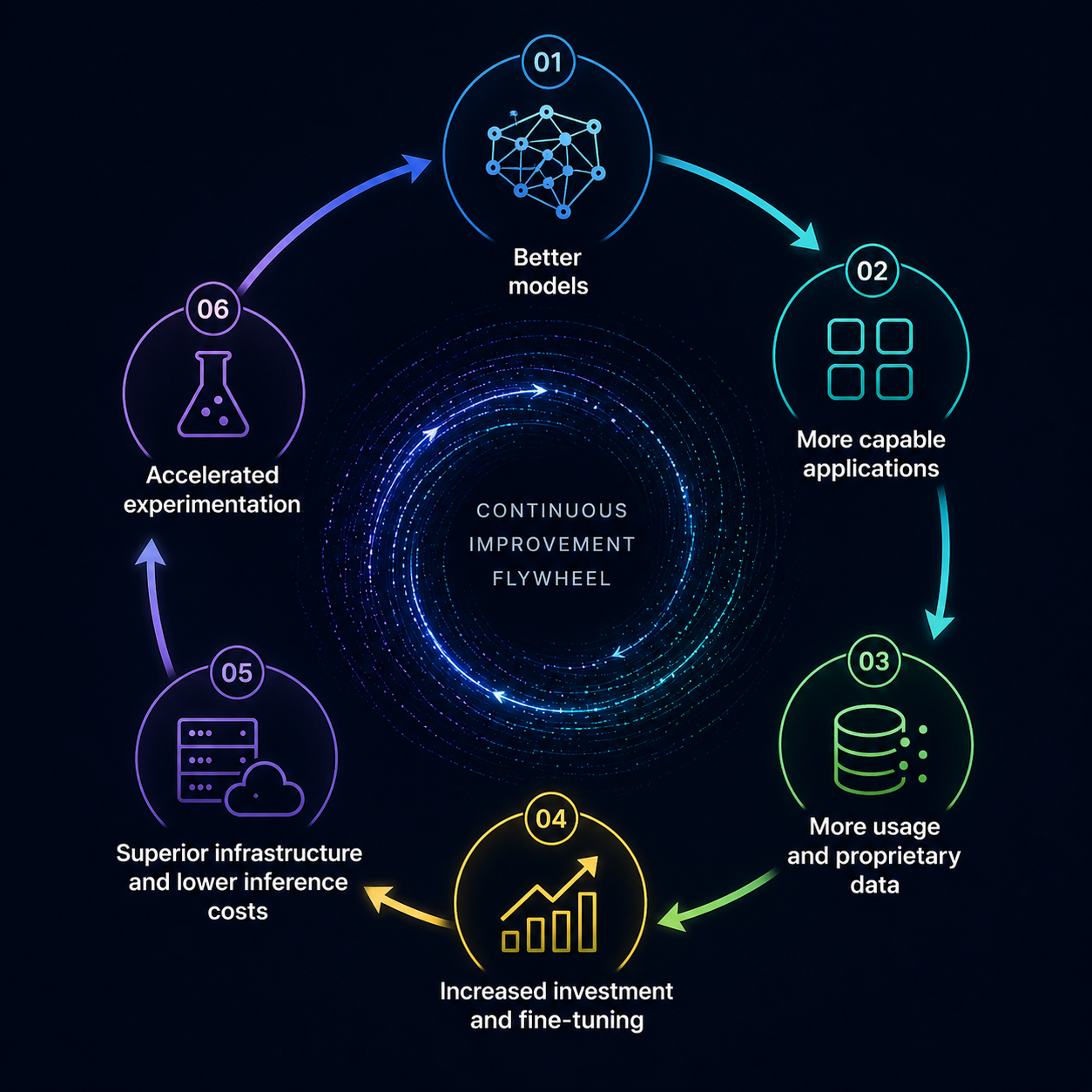
This loop fueled by techniques like reinforcement learning from human feedback RLHF synthetic data generation and real time user signals creates compounding returns. NVIDIA and enterprise platforms explicitly design around data flywheels to combat model drift and drive continuous improvement. The result. Costs plummet while capabilities explode widening the gap between leaders and laggards.
AIs reach extends far beyond software:
Physical - Robotics autonomous manufacturing and logistics optimization.
Operational - Multi agent workflows that execute end to end processes autonomously.
Organizational - Flatter structures and hybrid infrastructure.
Defensive - Cyber systems that respond at machine speed.
The Uncomfortable Truth. Cloud Era Playbooks Are Obsolete
What propelled success in the cloud era elastic infrastructure DevOps workflows perimeter based security often becomes a liability in the AI era.
Cloud first economics frequently prove inefficient at AI scale. High utilization inference workloads can make on premises or hybrid setups 57 percent cheaper over 3 years versus cloud APIs for large token volumes with breakeven points reached in 11 to 12 months for sustained loads. Cloud convenience carries a 2 to 3 times premium at scale.
Traditional sequential workflows fracture when agentic AI systems enter. Autonomous agents now orchestrate multi step processes cutting audit reporting time by up to 92 percent or accelerating marketing content cycles by 4 times in real deployments.
Legacy security models lag behind machine speed threats. AI native defense requires real time adaptive controls.
Old IT operating models were built for stability and support not for continuous transformation and rapid redesign.
McKinseys 2025 State of AI survey underscores the gap. While 66 percent of organizations report productivity gains only 39 percent see measurable EBIT impact at enterprise level and just 34 percent are deeply reimagining processes rather than layering AI on surface level.
Winners Redesign the System. They Do Not Automate Brokens
The dominant pattern among high performers is clear. They treat AI as a system redesign catalyst not a bolt on optimizer.
This means:
Solving high stakes business problems with precision(e.g., agentic workflows in sales operations or supply chain) instead of chasing hype cycles.
Prioritizing velocity and iteration over perfection embracing the new cycle: Experiment → Learn → Redesign → Scale (versus the old: Study → Plan → Deploy → Optimize).
Building AI native organizations. Leaner teams hybrid human agent orchestration and new leadership models that treat governance and security as strategic enablers not afterthoughts.
Designing with people, not just deploying to them integrating agents to augment judgment while preserving human oversight for high stakes decisions.
Agentic systems are already proving transformative. One industrial firm slashed audit times dramatically. B2B sales teams now explore 10 to 20 times more scenarios.
The Ultimate Differentiator
The companies that dominate this era will not necessarily possess the absolute best foundational models. They will excel in three harder disciplines.
The courage to redesign core processes and architectures from the ground up.
The discipline to tie every AI initiative to quantifiable outcomes revenue efficiency risk reduction.
The speed to act while the technology window remains wide open because the gap between emerging and mainstream has collapsed.
PwC projects AI could add 15.7 trillion dollars to the global economy by 2030. Yet most organizations risk capturing only a fraction if they optimize the old world instead of rebuilding for the new.
AI is not waiting for permission pilots or perfect governance. It is accelerating relentlessly.