Loading blog post...
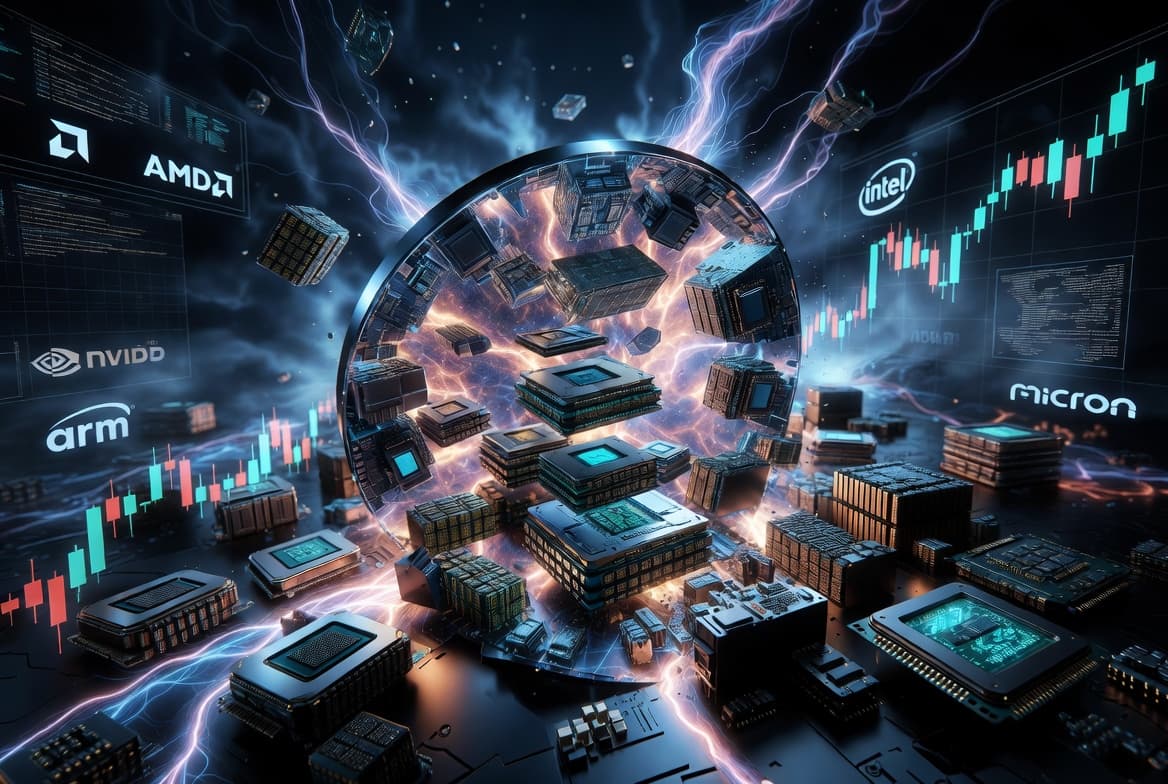
The AI revolution isn't just about generating text or images anymore. It's evolving into something far more powerful and compute-hungry: Agentic AI. This leap from reactive generative AI to proactive agentic workflows is reshaping data center architecture at a fundamental level. The computing bottleneck is shifting. GPUs remain critical for heavy parallel matrix operations in training and inference, but the orchestration, reasoning loops, tool-calling, memory management, and sequential decision-making of agents demand massive general-purpose compute. Enter CPUs, high-bandwidth memory (DRAM/HBM), and the entire supporting ecosystem.
The AI hardware frenzy is entering its next phase. While GPUs powered the initial surge in training and generative inference, Agentic AI is dramatically expanding compute needs across the entire silicon ecosystem. This shift is not replacing GPUs, it is amplifying demand for CPUs, high-bandwidth memory, advanced packaging, and supporting infrastructure, creating structural tailwinds for the broader semiconductor industry.
Why Agentic AI Devours more chips than Generative AI alone
Agentic workflows turn simple prompts into complex, multi-step processes: goal decomposition, tool calling (APIs, databases, code execution), long-context memory management, self-correction loops, and parallel agent orchestration. These operations create heavy sequential logic, state management, and orchestration overhead areas where general-purpose CPUs excel while still relying on GPUs for parallel matrix math during reasoning steps.
The result is a fundamental rebalancing of data center architecture. Traditional AI clusters often ran at CPU:GPU ratios of 1:4 to 1:8. Agentic systems are pushing this toward 1:1 to 1:2, with CPUs handling head-node control, feedback loops, and disaggregated tasks that keep GPUs from idling inefficiently.
Arm quantifies the scale: Conventional AI data centers require roughly 30 million CPU cores per gigawatt of power. In the agentic era, this jumps fourfold to 120 million cores per GW, driven by the need for more CPU racks, proximity to accelerators, and sustained orchestration.
$32.5–60 Billion Incremental CPU Value by 2030
Morgan Stanley’s April 2026 analysis shows the impact: Agentic AI is expected to add $32.5–60 billion in new value to the data-center CPU market by 2030 on top of a baseline already exceeding $100 billion. This pushes the total server CPU TAM potentially toward $160 billion, while GPU demand remains robust.
Memory faces similar pressure. Agentic workloads could drive an additional 15–45 exabytes of DRAM demand by 2030 equivalent to 26–77% of 2027’s entire annual DRAM supply. This intensifies competition for HBM (high-bandwidth memory) and standard DRAM alike, tightening an already constrained supply chain.
Broader forecasts show CPU market growth potentially outpacing GPUs in certain segments through 2029, fueled by reinforcement learning simulation, multi-agent coordination, and inference orchestration.
The Shift Is Already Visible: Shortages, Price Hikes, and Reallocations
CPU supply crunch: Intel and AMD have raised server CPU prices by 10–20% since March 2026, with consumer CPUs up 5–10%. Lead times stretch to 6+ months. Intel and AMD are reporting strong double-digit server CPU growth, explicitly tied to agentic demand. Intel is reallocating wafer capacity from client to server Xeon lines. Further hikes (another 8–10% in H2 for Intel; cumulative 16–17% for AMD server CPUs) are expected through 2026–2027.
Ratio tightening in real time: Intel’s Q1 2026 earnings confirmed the CPU:GPU deployment ratio has already moved from 1:8 toward 1:4, with potential convergence to 1:1 in agentic-heavy clusters. AMD executives noted “strong double-digit” server CPU growth in 2026, explicitly tied to agentic and traditional CPU tasks spawned by agents.
Hyperscaler and vendor signals: Nvidia highlights CPUs as an emerging bottleneck in agentic workflows and has expanded its own CPU offerings (Grace/Vera). Arm launched its first in-house data-center AGI CPU targeting orchestration demands. Hyperscalers are accelerating custom silicon and CPU-heavy designs.
Memory and manufacturing strain: HBM and advanced DRAM capacity is sold out well into 2026–2027. Micron (MU) crossed $500/share for the first time after a ~76% YTD rally, with investors citing massive agentic-driven HBM/DRAM opportunity and ties to Nvidia’s Vera Rubin platform. TSMC reports advanced-node and CoWoS packaging capacity fully utilized, with AI silicon demand (GPUs + CPUs + memory interfaces) projected to keep shortages lingering beyond 2027.
These developments mark a clear expansion of the AI silicon opportunity beyond the GPU-centric narrative of 2023–2025.
Key Beneficiaries: Computation Power Leaders
CPU leaders: AMD (EPYC) and Intel (Xeon) gain from higher attach rates and pricing power in orchestration/head-node roles. Arm Holdings benefits via licensing (hyperscaler custom CPUs) plus its own AGI CPU push, with analysts eyeing $1B+ revenue potential from data center designs. Nvidia (Grace/Vera) captures integrated CPU-GPU wins.
Memory powerhouses: Micron, Samsung, and SK hynix face sold-out HBM/DRAM capacity through 2026–2027, supporting margin expansion and pricing strength amid agentic memory walls.
Foundry & Equipment : TSMC (advanced nodes + CoWoS packaging) and ASML (EUV/DUV lithography) see accelerated demand as the entire stack scales. Both raised 2026 guidance on AI buildout.
GPU Boss: Nvidia remains central but the incremental opportunity now spreads value across the ecosystem, reducing single-stock concentration risk for investors.
The net effect is a larger total addressable market for semiconductors in data centers, with AI infrastructure spend potentially driving hundreds of billions annually by 2030. Agentic AI turns what was primarily a GPU story into a full-stack silicon supercycle, more wafers, more memory, more advanced packaging, and sustained CapEx from hyperscalers.
Agentic AI Is Expanding the Silicon Industry
Agentic AI multiplies overall compute intensity by layering orchestration, memory movement, and iterative execution on top of raw acceleration. The computing bottleneck is broadening from parallel throughput to balanced, general-purpose systems.
For the semiconductor sector, this means a second demand engine running alongside GPU growth: higher CPU attach rates, exploding memory needs, and re-architected data centers. Supply chains are scrambling, prices are adjusting upward, and capacity expansions are racing to catch up.
The GPU gold rush built the foundation. Agentic AI is now widening the playing field, driving deeper, broader, and more sustained demand across CPUs, memory, and the entire silicon ecosystem. The chip industry isn’t just riding one wave; it’s entering a multi-layered boom.